Why Neighborhood Groups Keep Meeting Minutes
Why neighborhood groups keep meeting minutes: record decisions, assign follow-up, and give absent members a clear place to rejoin the work.
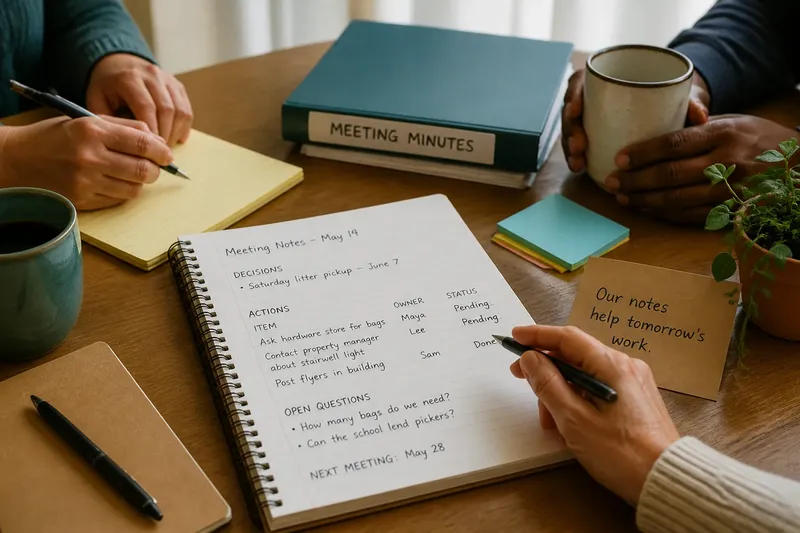
At a neighborhood association meeting, the folding chairs are nearly stacked when someone asks who agreed to call the library. The answer sounded clear in the room; now it belongs to several memories. Meeting minutes give neighborhood groups a shared account of decisions and follow-up, not a claim to record every conversation.
Decisions and follow-up
Minutes are useful when group work carries on between meetings. They can record what members chose, who agreed to act, and what remains undecided. This is narrower than a history of the group, and more useful for getting Tuesday’s task through Wednesday.
A decision without an owner is easy to admire and hard to complete. A note that says “ask the recreation center about room availability” is less useful than one that names the person who will ask and marks the answer as pending. The record connects a choice to its next action.
Say a fictional block club agrees to hold a Saturday litter pickup. Members decide to ask the hardware store for bags, and Maya takes that task, but the quantity is not yet settled. The note records the event, Maya’s follow-up, and the open question. At the next meeting, the club can check whether she received an answer and decide what to do; it does not have to reconstruct who volunteered.
A working record
Meeting minutes are selective. They are not a transcript, diary, or verdict on how everyone felt. Their job is to keep the group’s work legible: what was decided, what needs action, and what still needs a decision.
Brief context can help a later reader understand an outcome. “Use the side entrance for deliveries” may seem arbitrary on its own. Adding “to keep the main doorway clear during children’s activities” explains the reason without turning the minutes into a replay of the discussion.
Distinguish decisions from proposals. “Members agreed to ask the school about using its hall” records an agreed action; it does not imply that the school granted permission or that a date is settled. Plain wording keeps intention from quietly becoming fact.
Who maintains them
The record belongs to the group, not permanently to the person who typed it. A secretary or rotating note-taker can draft the minutes, while members check that the wording reflects what was decided. If an item is unclear, mark it as unresolved rather than polishing uncertainty into a confident sentence.
Groups can use a shared Google Doc, a folder in Dropbox, or a paper binder kept with the meeting materials. The particular tool matters less than knowing where the current record lives and who can update it. If minutes contain sensitive personal details, keep them out of broadly shared notes and ask the group what access rules apply.
A simple record can include the meeting date, decisions, assigned actions, open questions, and corrections to earlier notes. The format should fit the group’s work. A tenants’ association may need to track a repair request; a garden club may need to note who will contact a compost supplier.
Minutes in practice?
What should meeting minutes include?
Record the decisions, the person responsible for each follow-up, and any question the group has not settled. Add a short reason when it will help members understand the choice later.
Should minutes capture every discussion?
No. Include the outcome and enough context to make it understandable, not every comment or exchange. A transcript is usually harder to use than a clear record.
What if members recall a decision differently?
Mark the wording as uncertain and ask the group to clarify it at the next meeting. Until then, do not present one person’s recollection as an agreed decision.
Where should a group store minutes?
Use a shared folder or paper binder that members can locate and maintain. Keep access limited when notes contain personal or sensitive information.
Review the open work
Before a meeting closes, a note-taker can scan the record for gaps. Each item should make clear what happened and what follows. If the next action has no owner, the group can assign one or leave the task explicitly unassigned.
- Decision: Check whether the note says what members chose. If it records only a proposal, label it as pending; otherwise, keep it as the agreed decision.
- Action owner: Check whether a person is named. If someone accepted the task, record that name; if no one did, mark it unassigned and ask the group to assign an owner or defer the task.
- Open question: Check whether unresolved details are visible. If the answer is unknown, leave the question open; if members settled it, record the answer rather than carrying forward an outdated uncertainty.
- Decision context: Check whether a later reader can understand the reason for a choice. If the reason matters to the next task, add a brief explanation; if not, keep the note concise.
- Earlier task: Check whether the previous minutes list unfinished work. If it is complete, mark it done; if it remains open, record the current status and next action.
- Access: Check whether the intended members can find the current record. If they cannot, move or share it through an agreed channel; if access is broader than intended, restrict it and discuss the group’s access rules.
Imagine a fictional tenants’ association reviewing a note that says, “Contact the property manager about the stairwell light.” The starting information is that members agreed to raise the issue, but the note names no caller and says nothing about the reply. At the review, the group confirms that Lee volunteered, adds Lee’s name, and leaves the response marked pending. At the next meeting, if Lee reports that the manager has been contacted, the group records that update and decides whether another follow-up is needed; if Lee has not made the call, it can ask Lee to proceed or assign the task to someone else. The note now distinguishes the agreement, the owner, and the result still awaited.
A record earns its place by helping the group resume its work without treating memory as a filing system. For neighborhood groups, clubs, and voluntary associations, useful meeting minutes keep decisions and follow-up visible while leaving the conversation itself where it belongs: with the people who were there.