A Handover That Leaves the Next Person Room to Begin
A volunteer handover checklist separates current tasks, useful contacts, open questions, and what can wait, so the next person can choose a workable start.
The outgoing treasurer leaves a folder, a stack of receipts, and a message marked “urgent” about a meeting that happened last month. A useful volunteer handover does less: it gives the next person a clear starting point, not a second job sorting the first one. The handover checklist should distinguish current tasks from useful contacts, open questions, and work that can wait.
Choose the handover shape
Groups tend to use one of three approaches: a written handover, a conversation, or a short overlap in the role. Each can work. The right choice depends on how much is unsettled, how easily the work can be explained, and how much time both volunteers can offer.
- Written handover: A shared document or printed sheet suits a role with recurring duties and a clear record trail, such as booking a room or sending the monthly notice. It lets the incoming volunteer read at their own pace. Its weakness is that an unanswered question can look deceptively settled.
- Conversation: A focused meeting suits a role shaped by relationships, tacit context, or a few decisions that need explanation. It gives the newcomer room to ask what a terse note means. Without a written record, though, names and next actions can blur together afterward.
- Short overlap: A limited period of shared responsibility suits a role with an approaching event, a live request, or a process that is hard to describe on paper. The newcomer can see the work in context. Keep the overlap bounded, or the former volunteer may remain the unofficial co-chair indefinitely.
Choose the lightest approach that answers the incoming person’s immediate questions. A quiet role with predictable tasks may need a page and a brief call. A role with active commitments may need all three, but not an exhaustive tour of the group’s entire past.
Handover checklist
Build the handover around four categories. They stop every item from arriving with the same apparent urgency.
- Current tasks: List only work already in motion. For each item, note the next action, the relevant date or trigger, and who is waiting for a response. If the task has no next action, it may not belong here.
- Useful contacts: Name the person, their connection to the task, and the best channel for reaching them. Include practical contacts such as the community-center booking desk or the person who holds the club’s shared mailbox. Avoid passing along private details that are not needed for the role.
- Open questions: Separate what is unknown from what is merely unfinished. Record the question, what has already been checked, and who might know more. Do not turn a guess into a decision by writing it in a tidy document.
- What can wait: Name worthwhile but nonurgent work, such as refreshing an old flyer or reviewing a dormant activity. Say plainly that it can wait, and note any reason it might become timely. A newcomer should not have to infer that “someday” means “before Thursday.”
- Access and boundaries: Identify the shared tools needed for the role, such as a group email account, a room-booking calendar, or a cabinet key, and say who can arrange access. State any established limit on the role’s authority, such as which spending or public announcements need approval.
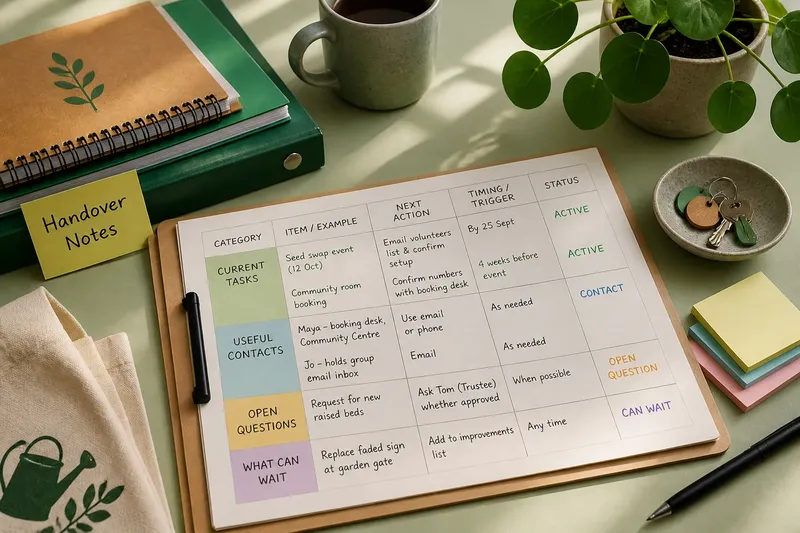
Keep each entry brief enough to scan. A simple table with columns for item, next action, timing, and status often works. Use ordinary language: “Ask Jo whether the library room is available for the autumn meeting” is more useful than “resolve venue issue.”
Sort urgency from inheritance
A handover can accidentally convert the outgoing volunteer’s entire mental list into the incoming volunteer’s obligations. Sorting by status prevents that. Mark each item as active, waiting on someone else, undecided, or deferred. These labels describe the work; they do not rate the newcomer.
Say a neighborhood garden coordinator is stepping down while the seed swap date is booked, a request for new raised beds is unanswered, and a faded sign could use replacing. The coordinator could hand over the booked event’s next contact and deadline as active, mark the bed request as an open question with the person who can approve it, and place the sign under “can wait.” The incoming volunteer can then prepare the event without being expected to resolve every improvement at once.
Before sending the document, ask the outgoing person to remove tasks that belong to another role, expired dates, and background that no longer affects a decision. The goal is not a complete account of everything the volunteer ever noticed. It is a reliable map of what the next person may need to act on.
Make the first exchange useful
A handover conversation works best when the incoming volunteer has seen the written notes first. That leaves the meeting for interpretation rather than dictation. Invite them to mark any item that seems unclear, premature, or outside the role.
Use the time to cover three things:
- Which active task has the nearest meaningful next action?
- Which contact can answer a question the notes cannot?
- Which decision can safely remain undecided for now?
Then agree on how the outgoing volunteer can be contacted, if at all, and for how long. A clean boundary helps both people: the newcomer gets a route for a genuine missing detail, while the former volunteer is not silently kept on duty.
Which approach fits?
When is a written handover enough?
Use writing alone when the role has repeatable tasks, current records, and few unresolved decisions. Make sure the incoming volunteer knows where the document lives and which items are active.
When should we add a conversation?
Add a conversation when a note depends on context, a contact relationship needs explaining, or an open question affects what happens next. The discussion should clarify the record, not create a second, unwritten version of it.
When does an overlap help?
Use a brief overlap when a live commitment is easier to observe than describe, such as welcoming performers before a community event. Set an end point and let the new volunteer take the lead on the next suitable task.
How do we choose what can wait?
Defer an item if no current commitment depends on it and postponing it does not create a problem for another person. Record any condition that would bring it back into view, such as a future booking request.
Leave a manageable start
Before calling the handover finished, read it from the incoming volunteer’s position. Can they tell what is active, whom to contact, what remains unknown, and what does not need attention yet? If not, revise the notes rather than adding more background.
A good volunteer handover checklist does not decide what the next person should care about. It makes the current situation legible enough for them to choose. The most useful final line may be permission to begin with the live work, leave the rest parked, and ask for context when a real decision calls for it.